

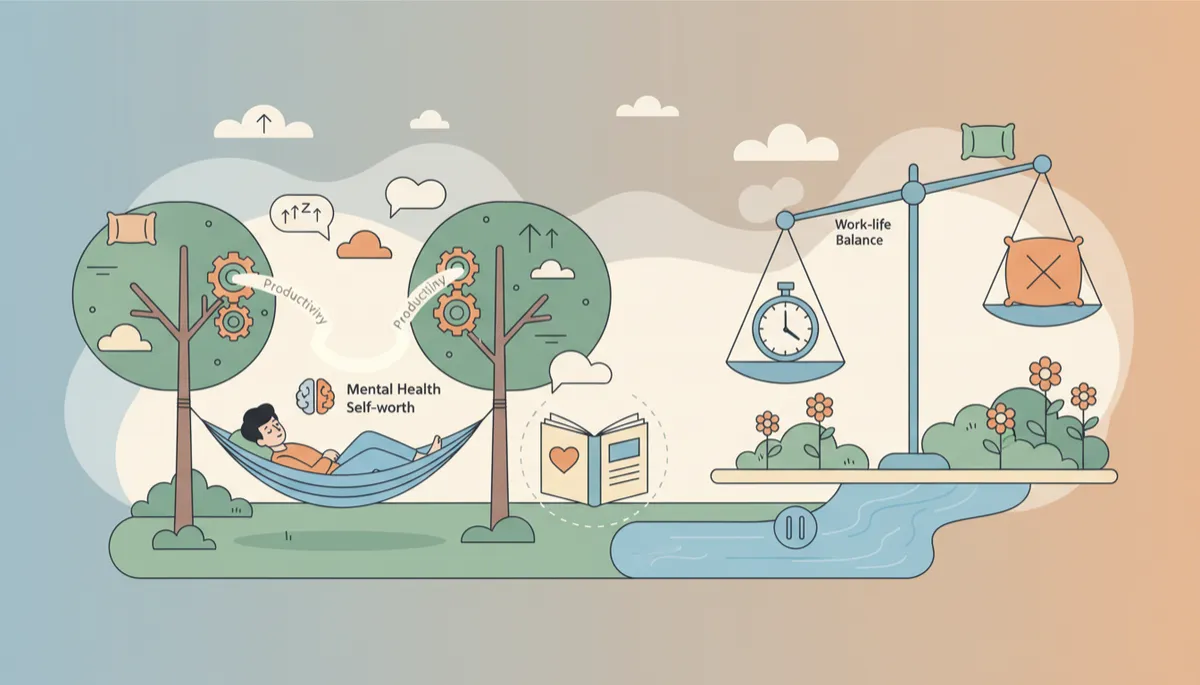
Rest Is Productive: Embrace Work-Life Balance
Rest, Productivity, Mental Health, Work-life Balance
Rest Is Productive Too: Why Your Worth Shouldn’t Be Measured by How Much You Get Done
We live in a world that claps the loudest for the busiest person in the room. Yet quietly, more of us are realising that constant hustle comes at a cost. At Inner Balance Studio, we believe that rest is not a reward you earn after being productive; it is a vital part of how you stay well, focused and genuinely fulfilled. This article explores why your self-worth should never be tied only to output, and how embracing downtime can actually support your mental health, productivity and work-life balance.
The Problem with Measuring Your Worth by Your To‑Do List
Many of us have quietly absorbed the belief that our value is linked to how much we achieve in a day. Long hours, overflowing inboxes and back‑to‑back meetings have become badges of honour. If we are not constantly “on”, we feel guilty, lazy, or as if we are falling behind. This mindset is so common that it can feel normal, even when it is slowly eroding our mental health and sense of self.
But here is the truth: you are not a machine. You are a human being with limits, emotions, and needs. When you measure your self-worth only by your output, you ignore everything else that makes you who you are — your kindness, creativity, relationships, resilience and capacity for joy. Productivity becomes the only lens through which you judge yourself, and anything that does not look like “doing” feels like a waste of time.
📌 Key Takeaway: Your worth is not a spreadsheet of tasks completed; it is inherent, unearned and unchanged by how busy you are.
What Rest Really Is (And What It Is Not)
When we say rest, many people picture collapsing on the sofa scrolling through their phone. While there is nothing wrong with a bit of mindless distraction, genuine rest is more intentional than that. It is any activity — or non‑activity — that allows your mind and body to recover, reset and breathe. It is the quiet in between the demands, the pause between tasks, the space where you come back to yourself instead of constantly reacting to the next notification or expectation.
Rest is not laziness. It is not giving up. It is not a sign that you are weak, unambitious or “behind”. In fact, the people who sustain meaningful productivity over years — not just weeks — are often those who understand the importance of downtime. They plan for it, protect it, and respect it as a non‑negotiable foundation of a healthy life and career.
💡 Pro Tip: Start by redefining rest as a form of maintenance, not a luxury. You would not expect your phone to run on 1% battery; why expect that from yourself?
How Rest Makes You More Productive (Not Less)
It might sound contradictory, but one of the most powerful ways to support your productivity is to rest well. When you are constantly exhausted, stressed and mentally overloaded, your brain simply cannot perform at its best. Concentration dips, decision‑making becomes harder, creativity dries up and small tasks start to feel overwhelming. You may still be “working”, but the quality and impact of that work steadily decline.
Rest changes that. When you step away from your desk to take a proper lunch, go for a short walk, or have an early night instead of pushing through, you are giving your brain the space it needs to process, file away information and reset. This is when insights surface, connections are made, and solutions appear that you could not see when you were forcing yourself to keep going. In other words, downtime is part of the work — it just looks different from typing or talking in meetings.

Short, intentional breaks often lead to clearer thinking and more focused work afterwards.
Studies in cognitive science repeatedly show that our brains work in cycles. We are not designed for endless concentration; we are built for rhythms of effort and recovery. When you honour those rhythms, your work-life balance improves and your output often becomes more effective, even if the total hours you work are fewer. You get more done that actually matters, instead of simply filling time to prove you are busy.
Rest and Mental Health: Why Slowing Down Is a Safeguard, Not a Risk
The link between rest and mental health is profound. Chronic stress, lack of sleep and never‑ending pressure to perform are major contributors to anxiety, burnout and low mood. When every day feels like a race you are trying not to lose, it is no wonder your nervous system stays on high alert. Over time, that takes a serious toll — not only emotionally, but physically too, affecting everything from your immune system to your digestion and heart health.
Rest acts as a buffer. It gives your body a chance to shift out of survival mode and into a calmer state where healing and recovery can happen. That might look like a quiet evening with a book, a gentle yoga class, a walk with a friend, or simply allowing yourself to do nothing without guilt. At Inner Balance Studio, we see time and again how people’s anxiety lessens and their mood steadies when they consistently build in small pockets of downtime throughout the week.
📌 Key Takeaway: Rest is not selfish. It is one of the most practical tools you have for protecting your mental health and showing up more fully for the people and work you care about.
Untangling Self‑Worth from Constant Productivity
If you have spent years equating busyness with value, it can feel deeply uncomfortable to slow down. You might worry that people will think you are not committed, that you will fall behind, or that you will like yourself less if you are not always achieving something. These fears are understandable — they are the natural result of a culture that celebrates output and rarely pauses to ask how people actually feel.
The first step in untangling your self-worth from your productivity is to notice the stories you tell yourself. Perhaps you catch your inner voice saying, “I did not do enough today,” or “I cannot rest until everything is finished.” When that happens, gently question it. Is it really true that you are only as good as your completed tasks? Would you say that to someone you care about? Probably not. You would recognise their humanity beyond their to‑do list; you deserve the same compassion.
Try shifting your daily reflection from “What did I achieve?” to “How did I honour my needs today?” That might include moments of rest, meaningful conversations, small acts of kindness, or simply surviving a difficult day. Over time, this reframing helps you see that you are worthy of care and respect regardless of how “productive” you were. Your value is not up for negotiation; it does not rise and fall with your output.
Rethinking Work‑Life Balance: More Than Just Squeezing in a Weekend
Work-life balance is often portrayed as a neat split between professional time and personal time, with the hope that if you can just manage your diary well enough, everything will fall into place. In reality, life is messier than that. There will be intense seasons at work and at home, and no calendar hack can change that completely. What you can change, however, is how you relate to those seasons and how fiercely you protect your need for downtime within them.
Instead of aiming for perfect balance every day, think in terms of rhythm. Are there small, regular ways you can weave rest into your week? A short walk before you open your laptop, a phone‑free lunch, a non‑negotiable bedtime, or a Sunday afternoon that is intentionally left unplanned? These pockets of restoration matter far more than the occasional big holiday that you are too burnt out to enjoy properly by the time it arrives.
💡 Pro Tip: Treat your rest like any other important commitment. Put it in your calendar, communicate it to others when needed, and resist the urge to cancel it for “just one more task”.
Practical Ways to Build More Rest into Your Day
Understanding the theory is one thing; changing your habits is another. Here are some gentle, realistic ways to bring more rest into your everyday life without feeling as though you are abandoning your responsibilities or your ambition.
Start small and specific. Instead of vowing to overhaul your entire routine, choose one small area to focus on. For example, “I will take a 10‑minute break away from my screen every afternoon,” or “I will not check emails after 8pm.” Small, consistent changes are more sustainable than dramatic overhauls that fade after a week.
Create simple rituals. Rest becomes easier when it is tied to a familiar pattern. A cup of tea after you finish work, a short stretch before bed, or a quiet moment with your journal in the morning can all serve as gentle anchors that remind your body and mind to slow down.
Protect your boundaries. You cannot have genuine work-life balance without some boundaries. That might mean saying no to extra tasks when your plate is already full, letting colleagues know when you are unavailable, or resisting the urge to respond instantly to every message. Boundaries are not barriers; they are the structures that allow both work and rest to coexist.
Notice how rest feels. Pay attention to the difference in your mood, focus and energy on days when you rest well versus days when you push through. This awareness can be a powerful motivator, reminding you that downtime is not an indulgence but a practical strategy for feeling and performing better.
Seek supportive spaces. Sometimes it is easier to honour your need for rest when you are in an environment that encourages it. Whether it is a local studio, a quiet café, a park, or simply a corner of your home that you keep clutter‑free, having a dedicated place to slow down can make a real difference. At Inner Balance Studio, for example, we design every session to be a pause from the noise, a space where you are not measured by your productivity at all.
Letting Go of Guilt Around Downtime
Even when you intellectually understand the importance of downtime, guilt can still creep in. You might find yourself sitting on the sofa, finally taking a break, only to feel restless and uneasy, as though you should be doing something “more useful”. This is not a sign that you are failing; it is a sign that you are unlearning a deep‑rooted pattern.
When guilt shows up, try naming it: “I notice I feel guilty for resting.” Then gently remind yourself why you are choosing to pause: “I am resting so I can support my mental health, be present with the people I love, and do my work more sustainably.” Over time, your nervous system will slowly learn that it is safe to relax, and those feelings of guilt will soften. Remember, you are practising a new skill — one that many of us were never taught, but deeply need.
Rest as an Act of Self‑Respect
At its heart, choosing to rest is an act of self‑respect. It is a way of saying, “My body, mind and emotions matter. I am not only here to produce, perform or please.” When you make rest a regular part of your life, you are not just improving your productivity or protecting your mental health; you are affirming that your self-worth is not up for debate. It does not depend on how perfectly you manage your inbox, how quickly you reply to messages, or how much you squeeze into a day.
This shift can be quietly radical. It challenges the idea that being constantly busy is something to be proud of and replaces it with a gentler, more sustainable truth: you are allowed to be a whole person, not just a productive one. You are allowed to have slow days, quiet evenings and weekends that are not optimised for anything other than simply being alive.
A Gentle Invitation to Redefine Productivity
As you move through the coming days, notice how often you equate your value with how much you have ticked off. Notice when you push yourself to keep going even though you are exhausted, and when you dismiss your need for rest as something you will “fit in later”. Then, if you feel able, experiment with a small act of rebellion: close your laptop on time, take that walk, say no to the extra task, or simply sit quietly with a cup of tea and let your shoulders drop.
At Inner Balance Studio, we see rest as a crucial part of a meaningful life, not an afterthought. We invite you to start seeing it that way too. Because when you honour your need for downtime, you are not falling behind — you are building the inner resources you need to move forward with clarity, compassion and strength. Your productivity may well improve, but more importantly, your days begin to feel more like your own.
📌 Final Thought: Rest is productive, but even if it were not, you would still deserve it. Your worth was never meant to be measured by how much you get done.